

Battery
Battery FAQ/Support
Battery Terminology
- Voltage/Electromotive Force (Volt,V,E): The electrical pressure driving electrons through a conductor.
- Open Circuit Voltage (OCV): The voltage of a battery in the absence of a charge or discharge current.
- Voltage Under Load (VUL): The voltage of a battery in the presence of a discharge current.
- End of Discharge Voltage (EODV): The voltage of a battery at the end of discharge while under load.
- End of Charge Voltage (EOCV): The voltage of a battery at the end of charge while still on charge.
- Specific Gravity (SG): The density (mass/volume) of the liquid (electrolyte) relative to water, at the same temperature.
- Ampere (A): The rate of flow of electrons. Electrical current.
- Ampere-Hour (AH): A measure of current over time. Battery capacity (Ampere-Hour = Amps x Hours).
- Watts (W): The rate of using energy to do work. (Watts = Volts x Amps).
- Watt-Hour (WH): The measure of power over time. Energy (Watt-hours = Volts x Amps x Hours).
How to handle batteries
Precaution
If treated with care and taking the proper precautions, lead acid batteries can be handled safely with minimum risk.
However, lead acid batteries contain sulfuric acid which is both poisonous and corrosive.
This makes them potentially hazardous and can cause serious injury when standard handling procedures and safety measures are not respected.
-

No sparks, flames or Smoking.
-

Shield eyes.
-

Keep children away.
-

Corrosive hazard.
-

Explosion hazard.
-

Read instruction manual carefully.
-

Flush eyes immediately with water. Get medical help fast.
Safety
- Always wear acid resistant clothing, protective goggles, PVC gloves and rubber boots.
- Avoid smoking, sparks and flames near operating or charging lead acid batteries.
- Keep metal objects away from terminals.
- Batteries are heavy. Lift carefully and do not place on unstable surfaces.
Emergency Action
- Splashes in eyes : Wash out the eye with plenty of water for at least 15 minutes.
- Splashes on skin : Remove contaminated clothing carefully and wash the affected skin areas with plenty of water.
- Swallowed : Drink copious amounts of milk of magnesia, water or milk. Do not induce vomiting.
Storage
- Keep batteries upright.
- Never stack over 4 layers.
- Batteries should not be directly exposed to the sun.
- Never drop, never overthrow.
- Keep batteries clean and always store in a cool, dry place.
- 5-Year
- A-MFG. Month
- K-Country
- J-MFG. Factory
- 01-Date
- Date Coding System on the Cover
ex)Date Code(MFG. Code) : 5AKJ01 means manufacturing date Jan.01.2015 - Year : 5(2015)
MFG. Month : A(JAN), B(FEB), C(MAR), D(APR), E(MAY), F(JUN), G(JUL), H(AUG), J(SEP), K(OCT), L(NOV), M(DEC)
MFG. Factory : J(Jeonju Plant), D(Daejeon Plant)
Installation and recharging
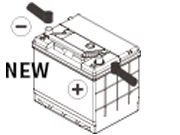
InstallationTurn off engine, all accessories and key off.
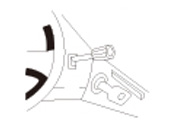
Remove the negative cable (Ground) first, and then positive cable from the old battery.
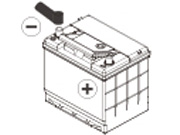
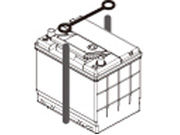
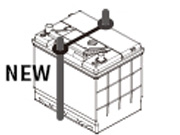
Recharging
If the battery is below 12.4V or fails to pass the load test, battery must be recharged as soon as possible to prevent lead sulfation. During charge, if the battery sprays electrolyte through the vent holes or gets hot (over 52℃), the charge must be stopped for a time to allow the battery to cool.
Constant current charge method
-
Measure the OCV(Open Circuit Voltage)of a discharged battery.
-
Set the OCV and capacity of the battery with moderate electric current and time stated below table.
-
Connect the battery to constant current charger and start charging.
-
When the charging time is completed, separate battery from the charger.
| State of Charge |
Sp.Gr | OCV | ~30Ah | ~40Ah | ~50Ah | ~60Ah | ~70Ah | ~80Ah | ~90Ah | ~100Ah | ~110Ah |
|---|---|---|---|---|---|---|---|---|---|---|---|
| 1.5A | 2.0A | 2.5A | 3.0A | 3.5A | 4.0A | 4.5A | 5.0A | 5.5A | |||
| 100% | 1.265 | 12.7 | - | ||||||||
| 75% | 1.225 | 12.4 | 6Hrs | ||||||||
| 50% | 1.190 | 12.2 | 12Hrs | ||||||||
| 25% | 1.155 | 12.0 | 18Hrs | ||||||||
| Discharge | 1.120 | 11.9 | 24Hrs | ||||||||
Constant voltage charge method
-
Connect the discharged battery to constant voltage charger.
-
Charge for 24 hours as following voltage upon battery type.
- 12V MF Battery: 16V
- 12V AGM Battery: 14.4V -
When the charging time is completed, separate battery from the charger.
Battery testing procedure
Test
Visual check
- Check the Container, Cover and Terminals. Where physical damage is present, replace the battery.
- Check the Indicator (If the battery has the Indicator). Always look right down when viewing the Indicator and lightly tap the Indicator on the battery to dislodge any air bubbles
 Good Condition
 Charging Necessary
 Replace Battery
Voltage check
- If OCV is below 12.4V, recharge the battery immediately.
Discharge Test(Load Test)
- Connect the battery tester to battery terminals.
- Measure the temperature of the battery around.
- Set the battery tester ampere values for ½ of the CCA rating.
- Apply the load for 15 seconds and read the voltage.
- Compare measured values with values in TABLE 2.If the values are outside of the table values, recharge the battery and test again.
- If the battery fails the load test twice, replace it.
- Sometimes, electronic testers such as MIDTRONICS, SNAP-ON and etc are used instead of load tester.
- Electronic testers are only suitable for batteries that have been in use for a certain time.
- They cannot rate the performance of new or unused batteries.
- For this reason, we recommend the test defined in global standards to confirm rated specifications.
State of Charge
| Approximate State of Charge | OCV |
|---|---|
| 100 % | 12.75 |
| 75 % | 12.40 |
| 50 % | 12.20 |
| 25 % | 12.00 |
| Discharged | 11.90 |
Load Test
| Minimum Voltage | Temperature |
|---|---|
| 9.6V | 21 ℃ above |
| 9.4V | 10 ℃ |
| 9.1V | -1 ℃ |
| 8.9V | -7 ℃ |
| 8.5V | -18 ℃ |
**For reference only
Will driving a car fully recharge a battery?
There are a number of factors affecting an alternator's ability to adequately charge a battery. The greatest factors are:
- How much current (amps) from the alternator is diverted to the battery to charge
- How long the current is available (drive time)
- Battery temperature
- Battery age
Generally, running the engine at idle or short stop-and-go trips, during bad weather at night, will not recharge the battery effectively.
In the following situations, the alternator will not adequately recharge a battery:
- The battery is drained because an interior light was left on in the car for 18-24 hours.
- The battery is drained because the vehicle has not been driven for a month or more.
- The car is only driven at 60 km/h (35 mph) to a nearby store and back 2 or 3 days a week.
What are cold cranking amps (CCA)?
For example, a 12-volt battery with a 650 CCA rating means the battery will provide 650 amps for 30 seconds at -18° C (0 °F) before the voltage falls to 7.20 V for a 12 V battery. So in extremely cold temperatures, the higher CCA level is required to crank your engine. In addition, as more cranking power is used, the amount of battery power available decreases.
How do I know when it is time to replace the battery in my car?
There may be little or no warning. However, if any of the following happen, your battery should be tested immediately:
- Motor has difficulty cranking over
- Battery indicator light on the instrument panel stays lit for extended periods after starting. This could also be a mechanical issue (possible alternator) and should be checked by a professional mechanic.
- Headlights dim when the engine is idling
- Clock starts to lose time after the vehicle sits unused for several days
Note: To maximize the vehicle's battery/charging system service life and performance, it is recommended a vehicle's battery and charging system be tested at least semiannually or every time the oil is changed.
How does a maintenance free, flooded battery work?
- Wet Maintenance free batteries are designed with Lead and Calcium alloy in the positive and negative plate chemistry or formulation.
- A more functional and effective design than traditional batteries with removable vent caps.
- Sealed batteries of this design have longer water retention and are a far more robust battery for today’s climates and conditions.
Other benefits include:
- Less preventive maintenance due to less water loss
- More forgiving when accidentally overcharged
- Reduced terminal corrosion and ventilation
- Lower discharge rate
- Less risk to users due to it’s maintenance-free construction
- Higher charge acceptance
Our Brands


